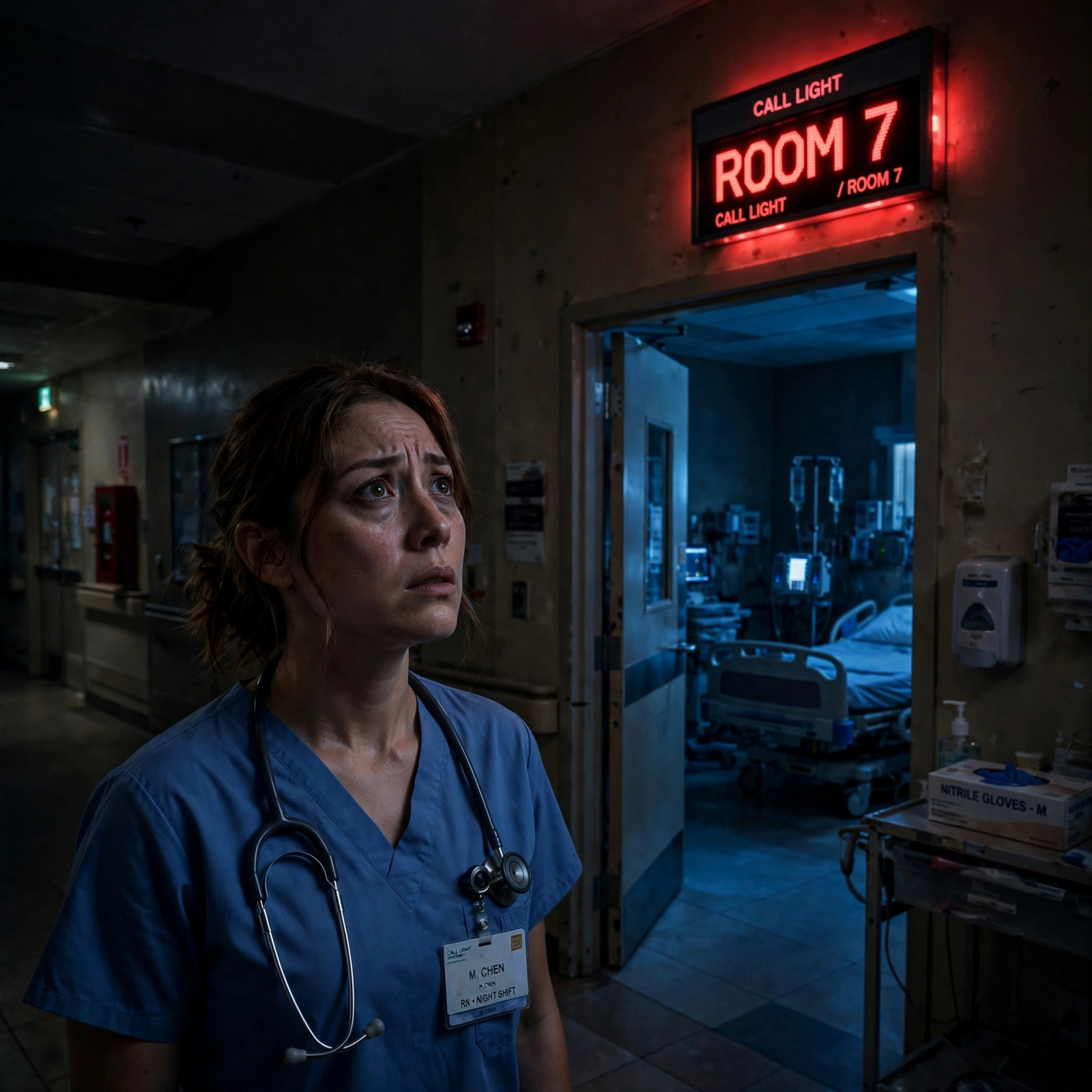
Elena Vasquez had worked the night shift at St. Mercy Hospital for nine years, and she knew its sounds the way a mother knows her child's breathing. The ventilator's sigh on the second floor. The elevator's tired groan. The soft rubber squeak of her own shoes on the linoleum at 2 AM, when the whole building seemed to hold its breath.
And she knew about Room 7.
Every nurse on the ward knew about Room 7. A year ago, an eight-year-old boy named Tommy Hale had died there — the hospital owner's only son, taken by a sudden infection no one saw coming. Mr. Hale, the billionaire who owned St. Mercy and half the city block it stood on, had paid to keep the room sealed and empty. "No patients. No storage. Nothing," he had ordered, his voice flat with grief. The door stayed shut. The bed stayed made. Nobody talked about it.
Until the night the call light started blinking.
It was 3:07 AM on a Tuesday — Elena remembered the exact minute because she had just glanced at the nurses' station clock. The board lit up: ROOM 7. She stared at it. Then she laughed, a short nervous sound, and told herself it was a wiring fault. Old building. Old wires.
But her hands were shaking as she walked down that hallway.
She pushed the door open. The room was dark and cold, the bed empty, the sheets pulled tight and ice-cold to the touch. Nobody had been in that bed for a year. And yet — the call button on the bedside rail was warm. Warm, like someone had just been holding it.
"Elena."
She froze. A small voice, thin as paper, whispering her name — from the bathroom doorway. She spun around. Nothing. Just tile and shadow and her own hammering heart.
She ran.
Marcus, the overnight security guard, found her white-faced at the nurses' station. He didn't laugh. He pulled up the corridor camera on his monitor and rewound to 3:07 AM. The hallway was empty. Then — a small shadow, no taller than a child, crossed the frame and slipped straight through Room 7's closed door.
"You saw nothing," Marcus said quietly. But his face had gone the color of milk.
By morning, Mr. Hale himself was standing in the ward, and Elena understood why powerful men frightened her more than ghosts. "My son died in that room a year ago," he said, "and I paid good money to keep it empty. Stop asking questions, nurse. Some doors stay closed because of what waits behind them."
Elena nodded. She clocked out. She went home.
She did not stop asking questions.
The next night, she searched Room 7 herself — every drawer, every cabinet, under the bed. Under the mattress, her fingers found paper. A child's crayon drawing: a woman in blue scrubs holding a small hand. HER. In her uniform. Her name written across the top in wobbly letters: ELENA. And in the corner, a date.
Tomorrow's date.
Her blood turned to ice water.
That night — the date on the drawing — she went back at 3:07 AM with the crayon picture folded in her pocket. The call light was blinking. She opened the door, walked to the empty bed, and pressed the warm call button herself.
"Tommy," she said into the silent room. "I'm here. You don't have to call anymore."
The light went still. The cold lifted from the room like a held breath released. And for one heartbeat, she smelled crayons and sunshine — then nothing.
In the morning, the drawing was gone from her locker. On the nurses' station whiteboard, in a child's wobbly handwriting, were three words: "thank you elena."
Room 7's call light never blinked again. Mr. Hale had the room reopened within the month — for children, he said. For the ones who needed it most.
Elena still works the night shift. And some nights, at 3:07 AM, she walks past Room 7 and smiles — because she knows that some call lights aren't asking for help.
They're saying goodbye.