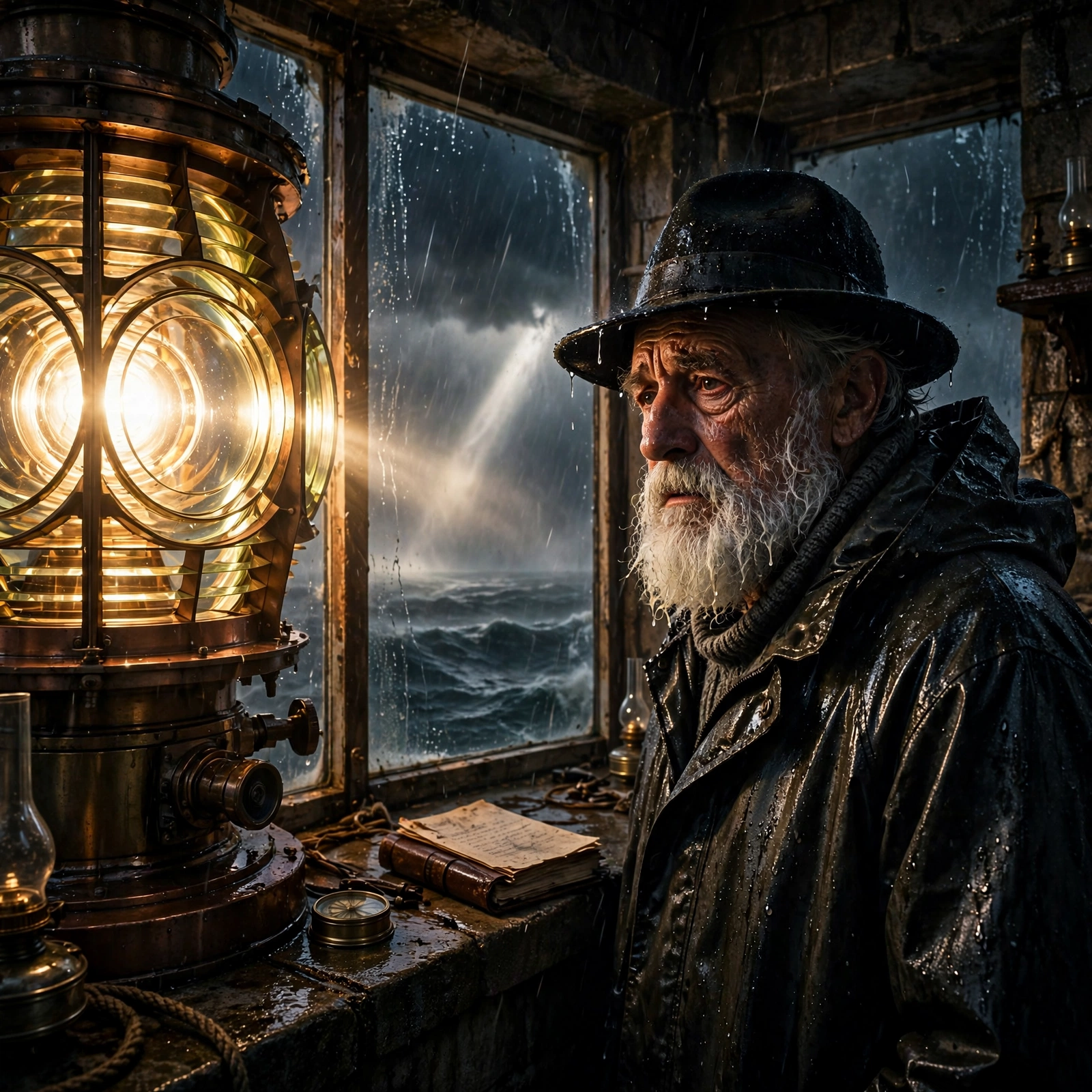
For thirty years, Elias Ward climbed the same ninety-four steps.
Every evening at dusk, no matter the weather, the old keeper of Graypoint Lighthouse filled the great lamp with oil, polished the Fresnel lens until it shone like a captured star, and lit the flame that had guided ships away from the rocks for over a century. And every evening, when the light began its slow sweep across the black water, Elias whispered the same words into the wind:
"Come home, Thomas. Bring my boy home."
Thomas Ward had been forty-one when the Marisol went down. It was the night of the great October storm, thirty years ago to the day. Thomas had taken his nine-year-old son, Daniel, out on the fishing boat for the boy's first real trip — a birthday promise, two days late because of rough seas. Elias had begged them to wait for morning. He could still hear his own voice shouting from the dock as the Marisol's lights faded into the rain.
They never came back.
The coast guard searched for eleven days. They found a life vest. A splintered oar. Nothing else. The sea at Graypoint keeps what it takes.
Elias was fifty-two then, the assistant keeper. When old Harlan retired the following spring, Elias took the post — and he never left. The townspeople of Grayport said grief had anchored him to the rock. They were right, though none of them understood the shape of it. Elias didn't stay to remember. He stayed to wait.
"A lighthouse keeper's first duty," he told the rare visitor, "is to make sure every ship finds its way home. Even the ones that are late."
So every night at nine o'clock, Elias opened the great leather logbook and wrote the same line, in the same careful hand:
Lamp lit. Sea empty.
Thirty years of the same line. Thirty years of dusk climbs, of oil and glass and wind.
Tonight was different.
Tonight was the anniversary — thirty years to the night — and the storm had come back like a thing with a memory. Rain hammered the lantern room glass in sheets. The wind screamed through the gallery railings. Elias lit the lamp at dusk as always, wrote his line at nine as always, and was turning to descend the stairs when he saw it.
A light. Out on the water.
No ship sailed in weather like this. Elias had watched this coast for sixty years and he knew every vessel's running lights the way other men knew their children's faces. This light was wrong — small, low, flickering, and moving. Moving toward the rocks. Toward the exact reef where the Marisol had gone down.
His hands shook as he lifted the old binoculars. The rain made it impossible to see clearly. But the light was there. Closer now. Closer.
He did what any keeper would do. He ran to the fog bell and pulled the rope with everything his seventy-eight-year-old body had. The great bronze bell swung and boomed, swung and boomed, warning the light away from the teeth of the reef.
And then, through the screaming wind, through the thunder of the bell — a voice.
Small. Clear. Impossible.
"Grandpa!"
Elias froze, the rope still in his hands. The bell's echo died. The wind seemed to hold its breath.
"Grandpa! Up here!"
He stumbled to the lantern room door, yanked it open —
The door had been locked from the inside. Elias knew this the way he knew his own heartbeat, because he had locked it himself at dusk, and no one else was in the lighthouse. No one had been in the lighthouse but him for thirty years.
But there, on the brass handle, glistening in the lamplight, was a small wet handprint.
A child's handprint.
And above him, the great lamp — the lamp he had secured himself, the lamp that had not moved on its own in the entire history of Graypoint — began to swing.
Slowly at first. Then wider. Sweeping its beam not out to sea, but down. Down toward the base of the rock. Down toward the old boat landing that had been abandoned for decades.
Elias Ward did not remember descending the ninety-four steps. He remembered only the rain on his face, the beam of his own lighthouse swinging ahead of him like a searching hand, and the small wet footprints on the stone steps below him — footprints too small for any man, leading down, down, down to the landing.
At the bottom of the steps, the beam settled on something that made the old keeper fall to his knees.
A wooden toy boat. Waterlogged, barnacled, half-rotted — the toy boat Elias himself had carved for Daniel's ninth birthday, the one the boy had carried aboard the Marisol that night, clutching it to his chest on the dock while Elias shouted at his father to turn back.
Thirty years on the ocean floor. And here it was. On dry stone. In the center of the light.
Beside it, in the wet sand of the landing, were two sets of footprints. One large — a man's boots. One small — a child's bare feet. They walked side by side to the water's edge.
And stopped.
Elias lifted his eyes to the sea. The small light was gone. The storm, impossibly, was easing — the rain thinning, the wind dropping to a whisper. And on that whisper came a voice, the voice of his son, forty-one forever, calling across thirty years of dark water:
"We found the light, Dad. We're coming home."
Elias Ward sat on the stone landing until dawn, holding the toy boat to his chest, while the great lamp of Graypoint burned above him — and for the first time in thirty years, when he climbed back up the ninety-four steps and opened the logbook, he did not write "Sea empty."
He wrote: "Lamp lit. They're coming home."